
Biloxi Previous Residents by Era
Match the era to the source before you chase an address history. A modern parcel links to recorded instruments through the Harrison County assessor. The current Chancery search covers them too. Older books demand a different route. The table separates an ownership trail from an occupancy trail. It also lists the fallback chain for early Biloxi research. Years mark documented coverage, not a promise that every name or image sits online.
| Source | Years It Covers | Where Held | What It Shows |
|---|---|---|---|
| Chancery land-record portal | Current index; JD2 deed-book scans back to 1959 | Harrison County online land records | Instrument parties, dates, book/page, parcel and legal-description leads |
| Virtual Index and Records Vault | Historic books; many county records reach 1841 | Chancery historic portal and Biloxi/Gulfport vault routes | Sectional index, book/page path, parcel-history research |
| Library deed microfilm | Deeds 1841-1886; index July 1841-March 1889 | Harrison Library Local History | Older deeds and index access |
| MDAH Harrison land and personal series | 1842-1899, with named earlier and correction records | Mississippi Department of Archives and History | Tax and land evidence outside the current portal |
| Cross-reference directories | 1986-95; 1997; 2000-01; 2004 | Harrison Library Local History | Published address-to-name connection |
| Biloxi directory and map material | Selected runs from 1904-2006; maps from 1893 onward | Library, Historical Society, and Library of Congress | Occupancy clues, street form, building and lot context |
Start at the current end when a parcel or street number is in hand. Start at the library when the question is nineteenth-century. The library is also the place when the address predates any online image. Each era rewards a different first move. The Biloxi city directory page describes the directory collection itself. Treat it as a dated household layer, never as a title record.
Biloxi Previous Residents Start
Freeze the address first. Record the street number, the exact street spelling, any unit, current and older name forms, Parcel ID, PPIN, lot and block language, and Section-Township-Range when the record supplies them. The Harrison County Property Search opens along owner, parcel, PPIN, address, and map routes. Results return Parcel ID, PPIN, Owner, Mailing Address, and Section-Township-Range, then point to map and property details. Those fields mean different things. An owner is a tax or property-roll field. A mailing address is where correspondence goes. The physical or situs address marks the parcel location, while a directory occupant is simply a person published at that address in one edition. Silently converting one into another corrupts the trail. The county's Property Search gives the current parcel lead, not a historical occupant roster. When an address search fails, strip the number, try the street type, or probe a nearby map position. PPIN, Parcel ID, and Section-Township-Range work as alternates. Keep the failed form too. It may expose a renamed street, a changed unit number, or a later subdivision pattern.
Biloxi Previous Residents and Deeds
Build the ownership chain backward from the modern parcel using the recorded land index. The Chancery portal accepts searches by street and number, parcel number, PPIN, grantor, grantee, matched name, instrument type, book/page, legal description, subdivision, block, lot, Section-Township-Range, or date. It also takes a date alone. Open any result. Retain the instrument number, book/page and type, file date, parties, related instruments, parcel or PPIN, legal description, and property details. That is the next backward step.
- Use the assessor result to carry the current Parcel ID, PPIN, and legal description into the Chancery search.
- Locate the current owner's purchase instrument and record the seller, purchaser, date, and earlier deed reference.
- Open Related Instruments or follow the prior book/page reference. Compare the legal description whenever the parcel or lot notation changes.
- Search the prior party and instrument details, then repeat the process backward one transfer at a time.
- Move to the Virtual Index, Records Vault, library microfilm, or MDAH when the needed book is older than the scan coverage.
- Grantor
- The party transferring an interest in a recorded instrument.
- Grantee
- The party receiving an interest in that instrument.
- Chain of title
- The sequence of recorded transfers used to trace an interest in a parcel through time.
- Legal description
- The lot, block, subdivision, or survey wording that ties older records to land more reliably than a street number alone.
A name on a deed is not always a name on a doorstep. Liens, releases, powers of attorney, deeds of trust, and lis pendens all list parties without moving title. For the document trail behind a Biloxi address, the Harrison County Land Records search is the route.
Biloxi Previous Residents Online Cutoff
The land-record screen opens with a default Begin Date of January 1, 1800. That number is not a promise. Harrison County's own historical notice puts scanned deed images at 1943 for Judicial District 1. Judicial District 2, the Biloxi district, starts at 1959. So treat 1959 as the documented benchmark for digitized book scans covering a Biloxi parcel. Lean on older channels for anything earlier.
The Virtual Index is the historic book-and-page route. The Chancery Records Vault keeps parcel-history indexes in Biloxi and Gulfport. Many county records go back to the county's 1841 creation. Harrison Library microfilm and MDAH collections stretch the chain further still. One address can span three sources. A portal result, a vault book, and an archival record each cover a different stretch of its history. Together they trace its past residents across the decades.
The historic index view sits inside the official Virtual Index.
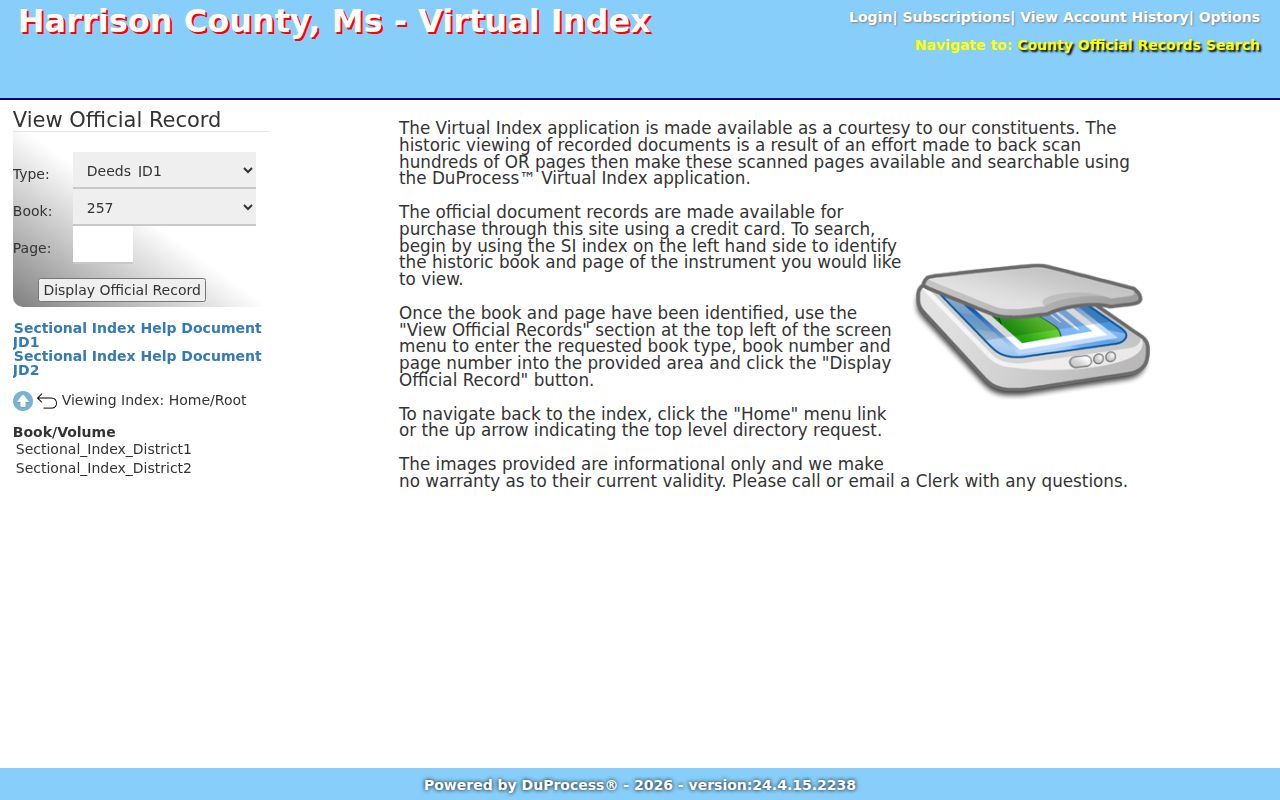
The screen also carries a book-and-page path for earlier Biloxi instruments. Check the deed image itself and its district coverage before drawing conclusions.
Note: The Records Vault does not give legal advice, title research, or lien searches; request copies and hire qualified help when legal certainty matters.
Biloxi Previous Residents by Directory
Once a deed chain pins down a period, cross-reference directories can add an occupancy lead. For 1986-95, 1997, 2000-01, and 2004, start with the address. Use the Mississippi Coast Cross Reference Directory. Transcribe the name it lists. Then check the ordinary directory for the same or nearest year. For earlier stretches, the library holds selected city, coastwide, telephone, and Keesler directories. The set begins with the 1904 Gulf Coast Business Directory and a 1905 Biloxi volume.
Every directory lead needs a second source. The 1905 sample entry for Mrs. M.T. Gilly shows groceries and No. 918 Reynoir Street, yet it proves neither ownership nor continuous residence. Pair the year and address with a deed, newspaper, census, cemetery, or court record. That habit keeps each role distinct. A business listing, an owner, a mailing addressee, and an occupant stay separate.
Harrison Library's resource guide catalogs the directory, newspaper, funeral, deed, and tax holdings. It also lists other local resources for past residents of Biloxi.
Biloxi Previous Residents and Census
A household trail needs dated sources. Guessing that one owner accounted for everyone at an address is a mistake. Biloxi historical collections hold Julia Guice transcriptions of the 1850, 1860, and 1870 censuses. They also hold an 1880 Harrison County census. Church, newspaper, cemetery, and funeral material rounds out the holdings. A residents directory can fill the quiet years between census days. A newspaper item or obituary can then explain why a name drops out of a street directory. The cause may be a move, a death, a spelling change, or a missing edition.
- Choose the directory or cross-reference year closest to the address event and copy the name exactly.
- Compare that name and street form with the applicable local census transcription, retaining the year of each source.
- Search the Daily Herald microfilm, which begins in 1888 but has a stated March 1964-August 1965 gap, when an event falls near the directory date.
- Use Bradford-O'Keefe funeral records, indexed 1901-1960, cemetery material, or a Chancery estate as a later documentary link.
- Return to the deed chain to see whether the household evidence overlaps a recorded transfer or merely the same address.
Someone tied to a Biloxi probate, funeral, or cemetery record may still have lived somewhere else entirely. Record the place and date each source actually states, and nothing more.
Biloxi Previous Residents Street Names
Old street names can quietly wreck an address search that otherwise looks correct. The Biloxi Historical Society notes that Pass Christian Road became Howard Avenue under Ordinance 98 on August 5, 1896. Search both names. Then compare what you find against a map, a deed legal description, a directory page, or a nearby landmark. A modern street name will not retrieve a record written before the change. Older Biloxi land descriptions may follow French long-lot or arpent patterns instead of a modern parcel card. Today's city rules assign property numbers, amend the property-number map through subdivision plats, and handle curving street segments in their own way. Keep the original lot, block, and legal-description wording rather than forcing every record into a current street number.
Biloxi Previous Residents After Katrina
Hurricane Katrina shaped what local research material survives and where it sits now. The former Biloxi local-history site took three to four feet of water and debris. Irreplaceable items were lost. A 2005 NEH grant helped stabilize and preserve the Powell collection. Local History consolidated downtown in October 2008. So a missing residents directory or clipping may reflect loss, relocation, replacement, microfilm, or a partial index rather than a gap in a person's past. That survival story argues for a broad search. When one source comes up empty, try the library catalog and staff, the Historical Society, the Chancery vault, MDAH, and any digitized collection. Each custodian may hold a different era or format.
Biloxi Previous Residents Map Context
Sanborn maps confirm a physical location, not the identity of an occupant. The Library of Congress July 1893 Biloxi record holds seven sheets. The Historical Society lists 1893, 1898, 1904, 1909, 1914, and 1925 map holdings. Biloxi Homes pairs map work with directory years, deeds, and court citations. Pick a date. These maps show a street layout. They show a lot, a building footprint, and the building's use. Check an address and legal description against the map. Do this before tying an old directory name to a modern parcel. Buildings get altered or replaced. A similar street number alone proves little. The map supplies the context layer. Dated directories and documents supply the person or party layer. Note: A Sanborn sheet can establish building context and street continuity, but it cannot prove who lived at a Biloxi address.
Biloxi Previous Residents Evidence
The Harrison Library research links gather newspapers, obituaries, cemetery resources, county records, and library access. It is all in one place for house-history work. A house history grows stronger when the deed transfer, the residents directory entry, the map context, and a later notice all agree. They should agree on the same address and period. When they clash, keep the conflict on file rather than picking the most convenient name. Consult the Biloxi house-history research links for the documented newspaper, obituary, cemetery, and county-record pathways.
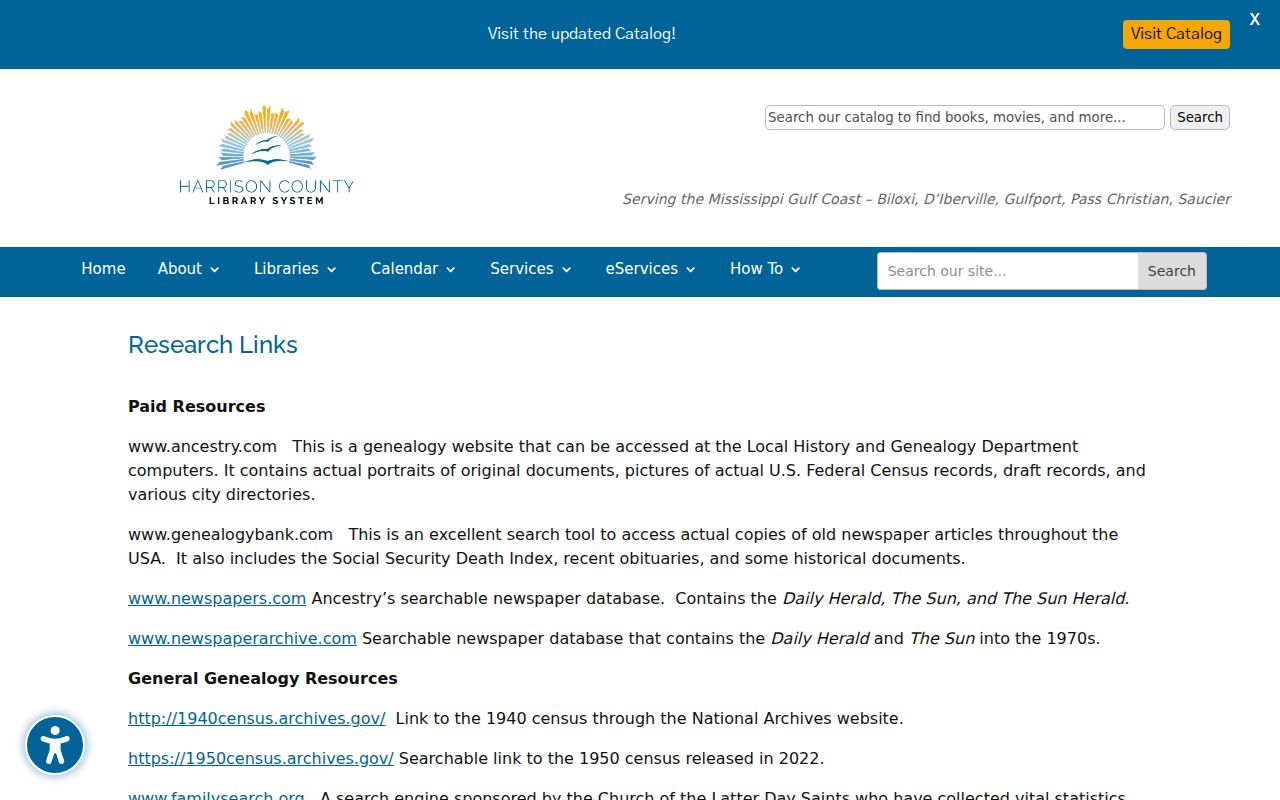
Those linked pathways help you move from a date and an address toward real local evidence. No single index should do the work of every record type.
Lawful house-history use. Biloxi previous-resident research can support family history, estate questions, and personal property curiosity. Do not use personal information to stalk, harass, or harm anyone.