
Biloxi City Directory Shelf and Collections
Biloxi's historical directory trail runs through the Harrison County Library System. Its Local History and Genealogy Department anchors that trail. The shelf there is a set of named runs, not one unbroken annual series. That distinction matters. A vanished name may just fall in a gap. The library's listed holdings keep regional, telephone, military, and reverse directories separate. City books sit apart from them. Materials are noncirculating, so confirm a volume is on hand before making a special trip.
| Collection | Years | Where Held | Access |
|---|---|---|---|
| Gulf Coast Business Directory | 1904 | Harrison Library Local History | Noncirculating reading-room material |
| Biloxi City Directory | 1905 | Harrison Library Local History | Request/check availability |
| Biloxi City Directory | 1913-14 | Harrison Library Local History | Reading-room consultation |
| Biloxi City Directory | 1922-23 | Harrison Library Local History | Reading-room consultation |
| Coast Cities Directory | 1927 | Harrison Library Local History | Regional coverage, in person |
| Biloxi City Directory | 1931; 1936; 1940-41 | Harrison Library Local History | Reading-room consultation |
| Mississippi Coast Telephone Directory | 1950-51 | Harrison Library Local History | Telephone-directory layer |
| Keesler AFB Telephone Directory | 1951 | Harrison Library Local History | Separate base-affiliation source |
| Biloxi City Directory | 1958 | Harrison Library Local History | Reading-room consultation |
| Polk's Biloxi City Directory | 1972-83; 1985-86; 1988-92 | Harrison Library Local History | Listed runs with gaps |
| Mississippi Gulf Coast Polk City Directory | 2003-06 | Harrison Library Local History | Regional, not Biloxi-only |
| Mississippi Coast Cross Reference Directory | 1986-95; 1997; 2000-01; 2004 | Harrison Library Local History | Reverse address-to-name route |
Treat each stated gap as a prompt to seek the closest edition, not proof that a household was absent. The 1904 book covers several Gulf Coast places. The 2003-06 Polk run is regional. Its pages can pull in nearby communities alongside Biloxi. Start with the library's directory shelf listing.
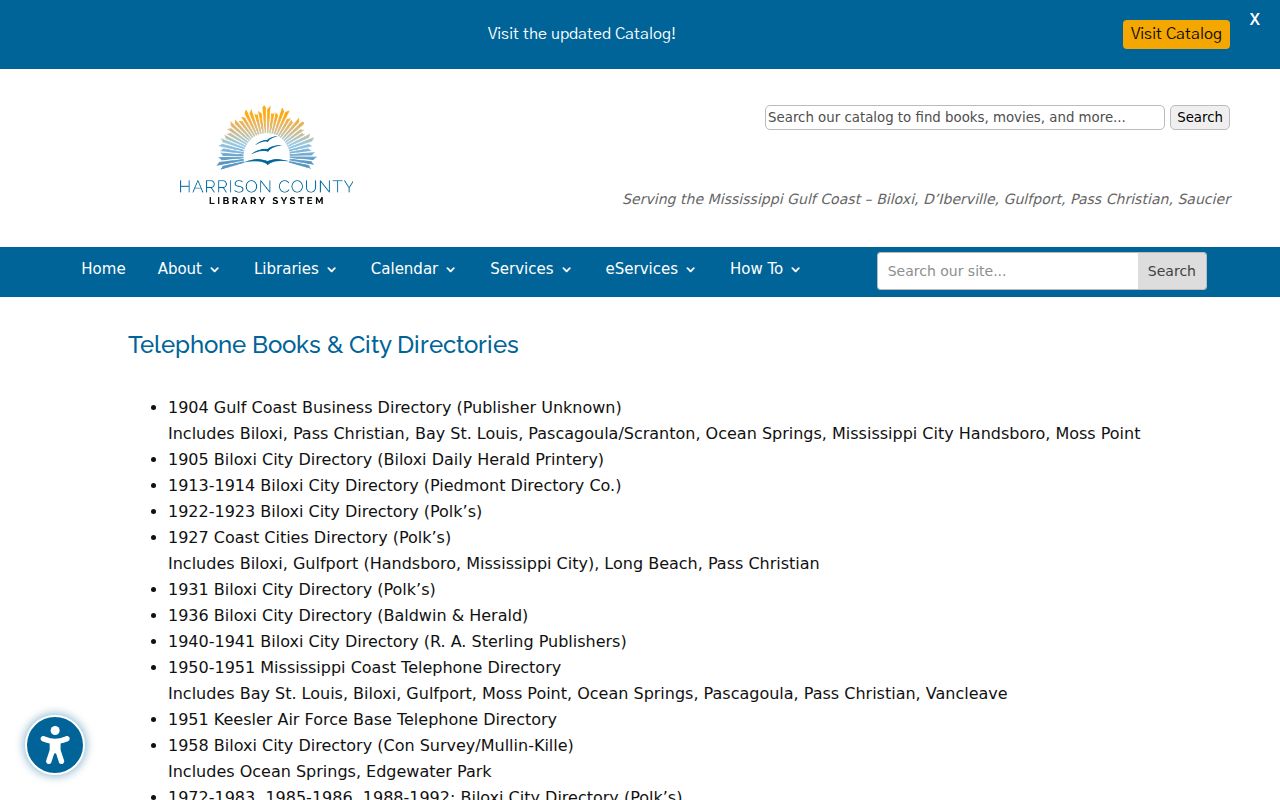
The shelf view is worth a look first. It reminds researchers to ask for a specific year and title, since city, coastwide, telephone, and cross-reference volumes sit side by side.
Biloxi Directory Local History Room
Harrison Library's Local History and Genealogy Department sits at 580 Howard Avenue in Biloxi. Staff answer questions at 228-435-4613 and genealogy@harrison.lib.ms.us. Nothing circulates; the collection stays in the reading room. Copies cost a small fee. You can order them in person, by phone, email, or mail. Those options count when a directory only exists on microfilm. They also count when a fragile volume needs staff handling, or you want just a few dated entries.
Come prepared. Bring the full name. Bring the likely year, an address if you have one, and any alternate spellings. Ask whether the Biloxi city directory you need is a bound book or microfilm. Also ask whether neighboring years are held too. The department also holds newspapers, funeral records, cemetery index cards, deed microfilm, and tax material that can test a directory lead. Treat a single entry as a clue. Then confirm it against another local source.
See the department through Harrison Library Local History and Genealogy.
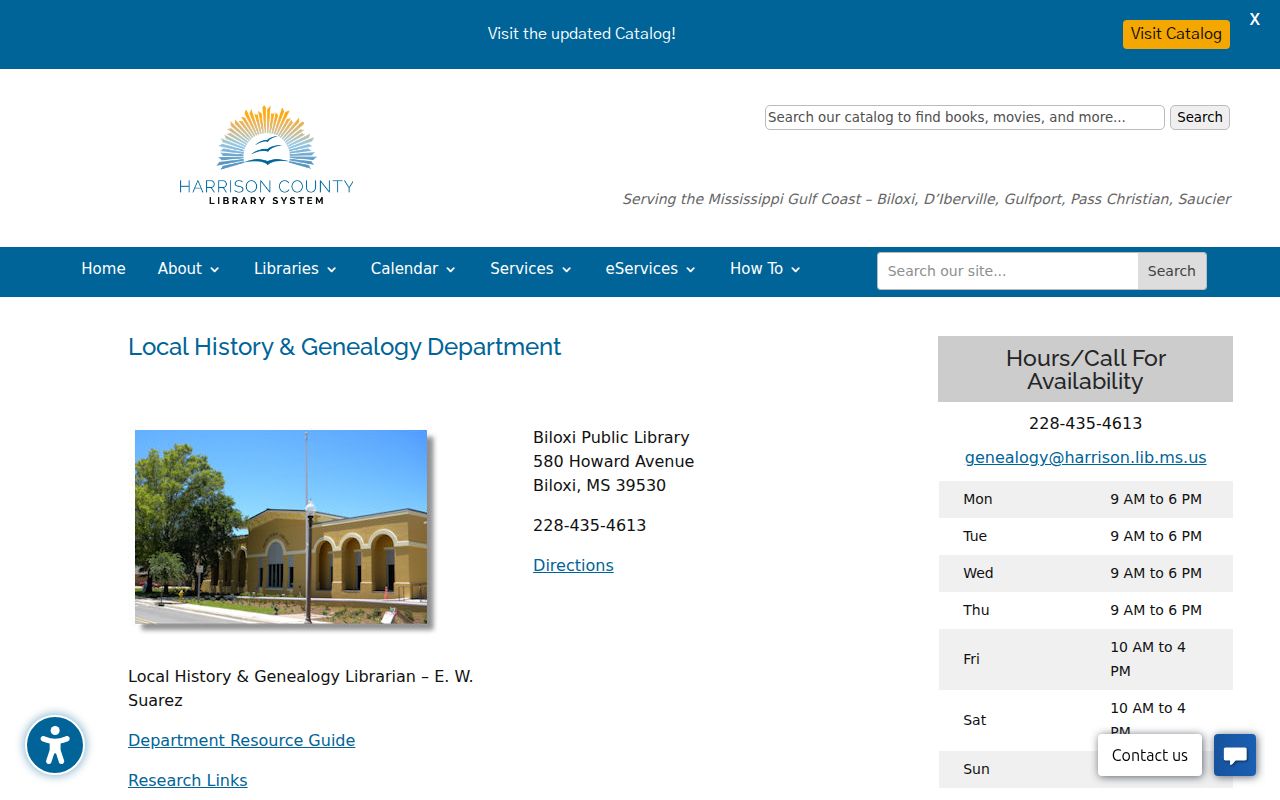
Digitized searches do not reach everything. The library is the practical fallback for a particular Biloxi directory edition and the surrounding local records.
Reading a Biloxi City Directory
Read a printed entry as evidence from one edition, not a modern identity record. The 1905 Biloxi sample names Mrs. M.T. Gilly. It lists groceries as the business and No. 918 Reynoir Street as the address, with advertisement text beside the entry. A later account adds a 1910 census reference. Name, work, and address appear together. It proves nothing about ownership, continuous presence, or any current tie to the property.
| Name and honorific | Mrs. M.T. Gilly identifies the person as printed in the 1905 entry. |
|---|---|
| Business or occupation | Groceries, which can connect a person to a trade or storefront. |
| Street location | No. 918 Reynoir Street, transcribed with its historical wording. |
| Advertisement text | Business wording that may supply a fuller search term. |
| Edition context | The year and surrounding entry context needed for a later check. |
Record the year, page, and exact spelling. The 1905 Biloxi directory sample supports the stated fields and its later census comparison.
- Criss-cross directory
- A reverse directory arranged by address, used to move from a street and number toward a listed name.
- Householder index
- An arrangement that points to the person or household as printed by the publisher, rather than proving ownership.
- Abbreviation key
- The volume's explanation of its shorthand. Read it before interpreting an unfamiliar mark or label.
Biloxi Reverse Directory Years
The Mississippi Coast Cross Reference Directory flips an address question into a name lead. It covers 1986-95, 1997, 2000-01, and 2004. Start with the year nearest the event. Transcribe the listed name, then open the conventional directory for the same or nearest year. A newspaper, deed, census transcription, cemetery index, or court record can then test whether the result matches the same person and place. The library's 1989 Biloxi Streets Cross-Reference Listing works the same address-to-name way. It appears in a digitized collection. The underlying Montage collection is free to search, browse, and view. The library publishes no direct deep link to it. Guessing a collection URL invites dead ends. Call or email for the access route. Note: A reverse listing connects a published address to a listed name for its edition year; it does not settle title or every person's presence there.
Biloxi Directory Publishers and Gaps
Publisher history helps identify the book in hand. The 1905 volume came from Biloxi Daily Herald Printery. Piedmont Directory Co. printed the 1913-14 edition, and Polk's produced the 1922-23 and 1927 books. Baldwin & Herald handled 1936, R.A. Sterling Publishers 1940-41, and Con Survey/Mullin-Kille the 1958 Biloxi book. These names separate local city editions from coastwide books.
| 1904 | Gulf Coast Business Directory begins the listed local shelf. |
|---|---|
| 1905 | Biloxi Daily Herald Printery provides a city-specific dated example. |
| 1913-41 | Piedmont, Polk's, Baldwin & Herald, and Sterling mark changing publishers. |
| 1950-58 | Coast telephone, Keesler, and Con Survey/Mullin-Kille volumes form separate layers. |
| 1972-2006 | Polk runs resume in selected periods, ending with regional Gulf Coast volumes. |
A second microfilm guide lists some dates that differ from the Harrison shelf. An NPS bibliography adds publisher context for further editions. Keep each citation with its repository. The library list notes a 1984 gap, and the NPS and library material differ around the 1948 and 1949 labels.
Biloxi City Directories for Families
A Biloxi residents directory works best as a year-by-year trail of a household. One volume shows the old address. The next shows a new street, a spouse's name, or a different line of work. Each small shift hands you a fresh search term. For the earliest years, the Historical Society holds Julia Guice transcriptions of the 1850, 1860, and 1870 censuses. It also holds an 1880 county census. Keep the directory year and the census year separate, though. The two record types were made at different times. They answer different questions about the same Biloxi family.
- Find the first plausible Biloxi city directory entry and copy the name, address, business, edition year, and page context.
- Check the next available listed year, rather than assuming every annual volume exists.
- Use a cross-reference year when the question begins with an address, then compare the conventional directory.
- Pair the dated name and address with the appropriate census transcription, newspaper, deed, cemetery, or court evidence.
- Preserve conflicting spellings, street names, and publisher details until another source resolves them.
A name that vanishes from a city directory is rarely proof of anything on its own. The household may have moved. A spelling may have shifted. Or the entry may simply be missing from the collection. Deaths matter here too. Bradford-O'Keefe funeral records run from 1901 to 1960, and local cemetery and obituary sources can carry the story forward. Treat a directory absence as a prompt for the next record, never as a conclusion.
Biloxi Directory Katrina Story
Katrina reshaped how Biloxi directories survived. The former Biloxi local-history site took on three to four feet of water and debris. Some material was lost for good. A 2005 NEH grant helped stabilize and preserve the Powell collection. In October 2008, Local History consolidated downtown. A missing Biloxi city directory may be lost, relocated, replaced, microfilmed, or indexed under a different scheme. That is very different from no directory ever being published.
Format matters just as much as survival. A modern catalog, a reading-room volume, a microfilm reel, a partial digital scan, and a historical-society citation can each describe a different slice of the same era. Ask the custodian which format is on the shelf and which years it truly covers.
Biloxi Directory Map Context
Maps can test the physical setting behind any street directory address. The Library of Congress holds a July 1893 Biloxi Sanborn set of seven sheets. Later map years appear in the Biloxi Historical Society holdings. The run covers 1898, 1904, 1909, 1914, and 1925. Biloxi Homes pairs its maps with selected 1936-1968 directories plus deed and court citations. A map reveals a street layout, a lot, a building, or a land use.
What it cannot do is name the occupant. The city directory supplies the dated name or business layer. Then a deed, census, or newspaper fills the rest, depending on the question. Street names shift too. Pass Christian Road became Howard Avenue in 1896. Try both when an old street search stalls.
Note: The 1893 sheets and later map runs build building context. They do not prove that a person lived at or owned a spot.
Biloxi Directory Society Sources
The Biloxi Historical Society rounds out any directory search. Its holdings include local books, church records, censuses, maps, and house-history examples. The Pringle family file cites a 1913-14 directory page for Frank E. Pringle and a Bolton Building business, then carries the story into the deeds. The society's artists material pairs directory addresses and occupations with census references the same way. Each case models a careful chain of sources rather than a single-record answer. Start with the Biloxi Historical Society research holdings before requesting records. You can also use it to check a historic address.
Society holdings let you set a directory finding beside census, church, map, and house-history material. No single source ever tells the whole story.