
Finding Biloxi Residents Through Records
Every Biloxi lookup starts with a question. Match the first record to it. An address points to the Harrison County property map, where a parcel can yield an owner name, legal description, and later land records. Old households fit library directories and newspaper files. A court question belongs in the right county or city court channel. These records overlap, yet none is interchangeable. A property card names an owner, not each resident. A directory entry places someone at an address only for its edition year.
Keep two independent details before calling anything a match. An exact address plus a date, a parcel number plus a deed party, or a directory address plus a newspaper notice beats a bare name every time. That habit prevents most false identifications. When the address itself is the starting point, the Biloxi street directory is the focused route.
- Search the county parcel record by street address, owner, parcel ID, PPIN, or Section-Township-Range.
- Record the physical address, owner, mailing address, and parcel identifiers as separate facts.
- Check the Chancery land index for the relevant deed or other recorded instrument.
- For a past name, use the library’s directory, obituary, newspaper, or funeral-record resources nearest the date.
- Use the custodian’s counter, phone, mail route, or a narrow public-records request when an online result is absent.
Biloxi Offices Behind Resident Records
Biloxi sits in Harrison County Judicial District 2. The county also runs Judicial District 1 in Gulfport. That split shapes Chancery, court, and older-record work. The Chancery Clerk records deeds and holds many estate, divorce, guardianship, and property filings. The Tax Assessor keeps the parcel and land-roll view. The Circuit Clerk handles voter registration, marriage records, and circuit-court channels. Each office has its own index, counter procedure, and copy route.
Start online when the search field fits. Otherwise use the counter or a narrow written request. The Chancery Records Vault can locate and copy older material by legal description, though it gives no legal advice and performs no title research. That boundary keeps a records search from turning into a conclusion about anyone's current circumstances.
Harrison Chancery Clerk, JD2
730 Dr. Martin Luther King Jr. Boulevard
Biloxi, MS 39530
228-435-8220
Harrison County Tax Assessor, JD2
730 Dr. Martin Luther King Jr. Boulevard
Biloxi, MS 39530
228-435-8263
Harrison Circuit Clerk, JD2
730 Dr. Martin Luther King Jr. Boulevard
Biloxi, MS 39530
228-435-8233
Biloxi Parcel Clues in Harrison GIS
Start with Harrison County's Property Search. It works with a street number, a parcel identifier, or an owner name. Map and advanced tools accept name, address, parcel ID, PPIN, and Section-Township-Range. A result can grow rich fast. Owner, mailing address, physical address, tax district, exemption, value, legal description, and improvement fields may all appear on one record. Keep the two addresses separate. A mailing contact may sit elsewhere. An owner field never lists everyone tied to a place.
| Harrison Property Search field | Use in a Biloxi record trail |
|---|---|
| Owner name | Starts a parcel search, subject to spelling and ownership-role limits. |
| Street address | Finds a physical-location record; remove the number or vary street type when needed. |
| Parcel ID or PPIN | Supplies a stable key for the map, land index, and related records. |
| Section-Township-Range | Helps identify land where the street form is incomplete or historic. |
Note: Save the parcel key and the date you searched. The county land roll and approved parcel layer can change.
Biloxi Names in Chancery Land Records
The Harrison land-records portal offers more than a name box. Its controls include grantor, grantee, matched-name, street and number, parcel number, PPIN, legal description, instrument type, date, consideration, and subdivision. A grantor transfers an interest. A grantee receives one. The index also shows instrument number, book and page, file date, related instruments, and property detail. Treat it as informational, not certified.
Historic images run on a different clock. The Chancery historical notice describes deed-book scans reaching roughly 1943 in Judicial District 1 and 1959 in Judicial District 2. For older Biloxi trails, start with the Virtual Index. Then turn to the records vault, library microfilm, or the Mississippi Department of Archives and History. A clerk supplies any official or certified copy.
Current Biloxi Resident Directory Sources
No single official directory lists everyone in Biloxi. Current sources each describe a different relationship to a place. The property roll identifies an owner and parcel fields. The land index records parties to instruments. The voter channel holds registration and precinct evidence under protected-field rules. A court index names a party to a case. A cemetery database records an interment. Pick the source that supports the fact in question. State plainly what it does not establish.
| Biloxi record trail | Connection it may show | Custodian | Access route |
|---|---|---|---|
| Parcel and land roll | Owner, physical/mailing address, PPIN, legal description | Harrison Tax Assessor | County GIS map and assessor search |
| Recorded-instrument index | Grantor, grantee, date, book/page, instrument role | Harrison Chancery Clerk | Land Records and Virtual Index |
| Voter registration channel | Registration and precinct evidence when lawfully requested | Mississippi SOS / Circuit Clerk | Verification form or voter-file program |
| City cemetery database | Interment, burial location, and sometimes photographs | City of Biloxi | Online database and cemetery contact |
| Historical directory shelf | Name, occupation, address, or business in a listed year | Harrison County Library System | Local History and Genealogy Department |
A current address calls for the parcel trail. An earlier household may point to a city directory. An obituary can serve just as well, so keep the record year, the person's role, and the access condition attached to every result.
Biloxi Voter Records Need Care
Mississippi's Am I Registered? form verifies one voter, not a city. It is no browseable Biloxi directory. The form asks for county, last name, first name, the last four digits of a Social Security number, and date of birth. Never expose those matching inputs. The statewide voter-file program carries its own access rules. Public fields include registration, address, ZIP, precinct, status, registration date, and district. Social Security numbers, phone numbers, dates of birth, and other protected details stay out.
A voter record can confirm an address lawfully. A name-only hit is not an identity match. Mississippi's Address Confidentiality Program gives qualifying victims of domestic violence, sexual abuse, or stalking a substitute address and mail forwarding. Respect that protection and any redaction.
Biloxi Public Records Beyond Portals
Some questions about a Biloxi address end in a records request. Other city matters do too. A lookup alone will not answer them. Under Biloxi Code §2-1-1, a request can be written. It can also be filed on a city form. You may make one in person instead. Name one subject. Describe the record you want clearly. The City Clerk accepts requests at City Hall, 140 Lameuse Street, by email at publicrecords@biloxi.ms.us, by mail to P.O. Box 429, Biloxi, MS 39533, or by fax at 228-435-6129. The ordinance allows seven working days for production or a detailed denial. It allows up to fourteen working days for production unless more time is needed.
The city forms and permits hub helps route a question, but it is not a person-by-address permit index. For a permit, planning, code, engineering, or preservation file, state the record type. Also give the address or PPIN and the date range. Fees appear in the ordinance: $0.35 for a one-sided copy, plus postage. Research runs $5 an hour. Computer-record work runs $50 an hour. All fees are subject to actual-cost limits. Read the Biloxi public-records ordinance and its request instructions before sending a targeted inquiry.
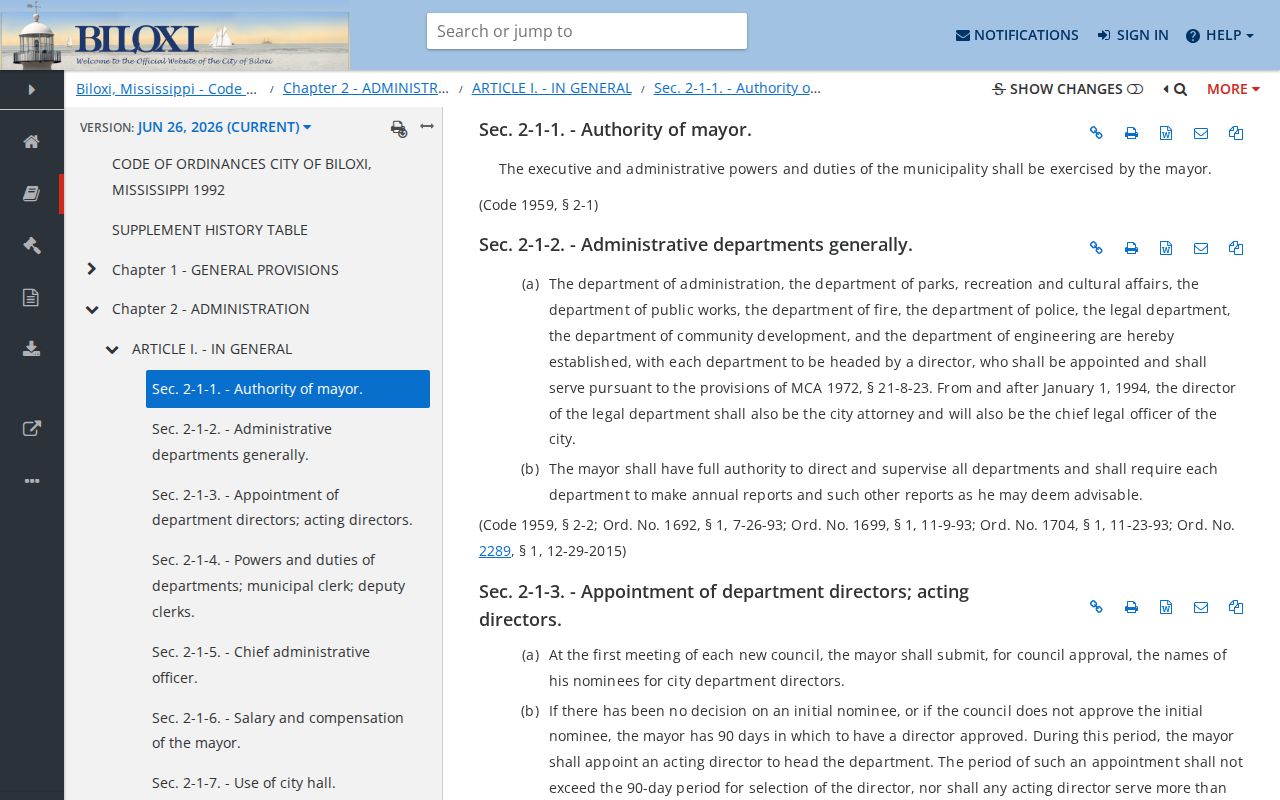
A posted Biloxi ordinance says more than a scattered name search ever will. Reading the actual text pins down what the city allows, so a focused records request beats a broad hunt for one person.
Biloxi Vital and Court Custody Paths
A certified vital record works differently from a genealogy lead. Mississippi Vital Records holds births and deaths from November 1912 forward. Certified copies stay limited to the person named. Close relatives listed by rule, authorized representatives, and a few other categories also qualify. Genealogy requests can still yield a plain-paper copy under the state forms. Marriage records split between two custodians. MSDH covers January 1, 1926 through June 30, 1938. It picks up again January 1, 1942 forward. The Circuit Clerk keeps the gap from July 1938 through December 1941. Divorce decrees sit with the Harrison Chancery Clerk, not MSDH. Route those requests to the county.
- Index
- A finding aid that points to a record, often without supplying a certified copy or full image.
- Parcel
- A mapped unit of land identified by a county key such as a Parcel ID or PPIN.
- Criss-cross directory
- An address-first directory that can lead from a street number to a listed name in that edition year.
- Certified copy
- A custodian-issued copy with the legal status needed when an official record is required.
County dockets deserve the same caution. A party name or case row might list a number, hearing date, or subject category, yet it cannot settle disposition, liability, or current status on its own. Restricted, sealed, juvenile, and expunged material may simply never appear online.
Biloxi Court Records by Jurisdiction
Start any Biloxi court search with the right jurisdiction. Harrison County's docket hub splits Chancery, Circuit, and Justice Court into separate search routes. Chancery handles estates, guardianships, divorces, name changes, and property proceedings. Circuit and Justice pages surface different party, case, date, hearing, and category fields. Biloxi Municipal Court is its own city channel. It covers traffic offenses and misdemeanors inside city limits. No public party-name form appears on the municipal page. So bring a full name, rough date, citation, or case number when you inquire there. Federal cases run through the Southern District of Mississippi and PACER instead of county indexes. An online docket hit is only an index lead, never the full file. Ask the responsible clerk for an eligible copy. Keep the court, judicial district, case number, and date attached to whatever you receive. That habit separates a current hearing listing from a complete proceeding. It also stops a simple name match from hardening into a final finding.
Note: Biloxi sits in Harrison County Judicial District 2. County records also run through Judicial District 1 routes in Gulfport.
Biloxi Residents in Historical Directories
The Harrison County Library System keeps a Local History and Genealogy Department. That department has a deep Biloxi shelf. Its city directory holdings run from a 1904 Gulf Coast business directory and the 1905 Biloxi City Directory. Later Polk editions and Mississippi Coast telephone books extend the run. Individual years include 1913–14, 1922–23, 1927, 1931, 1936, 1940–41, and 1958. Cross-reference volumes cover 1986–95, 1997, 2000–01, and 2004. These can walk a street address back to a listed name. Gaps exist between editions. The shelf is a set of discrete holdings, not proof of unbroken yearly coverage.
A single edition may tie a name, street address, occupation, or business to one year. It cannot prove ownership or continuous residence on its own. The publishers, entry-reading method, and library access routes are detailed in the Biloxi city directory collections.
Biloxi Cemetery Records as Dated Evidence
Start with the Old Biloxi Cemetery database when old Biloxi names matter. The city maintains it as a searchable set of burial names, plot locations, and photographs. According to the site, the oldest surviving tombstone dates to 1811. Above-ground tombs dominate because Biloxi sits on a high water table. The live page also posts its own tallies. It reports roughly 15,811 interment records. It also counts 8,712 plots. And it lists 1,096 photographed headstones in the old section. An October 2025 city publication gave a different figure, at least 16,000 burials. So any count should carry its date and source along with it.
A cemetery hit is a strong lead. It is not proof that someone lived next door. The question may be a household connection. In that case, pair the burial result with a Biloxi city directory, an obituary, a deed, or a vital record. That combination turns a grave marker into real residents directory evidence. Search the city cemetery records first. Then verify the name against other public rolls before drawing conclusions about where a past resident actually lived.
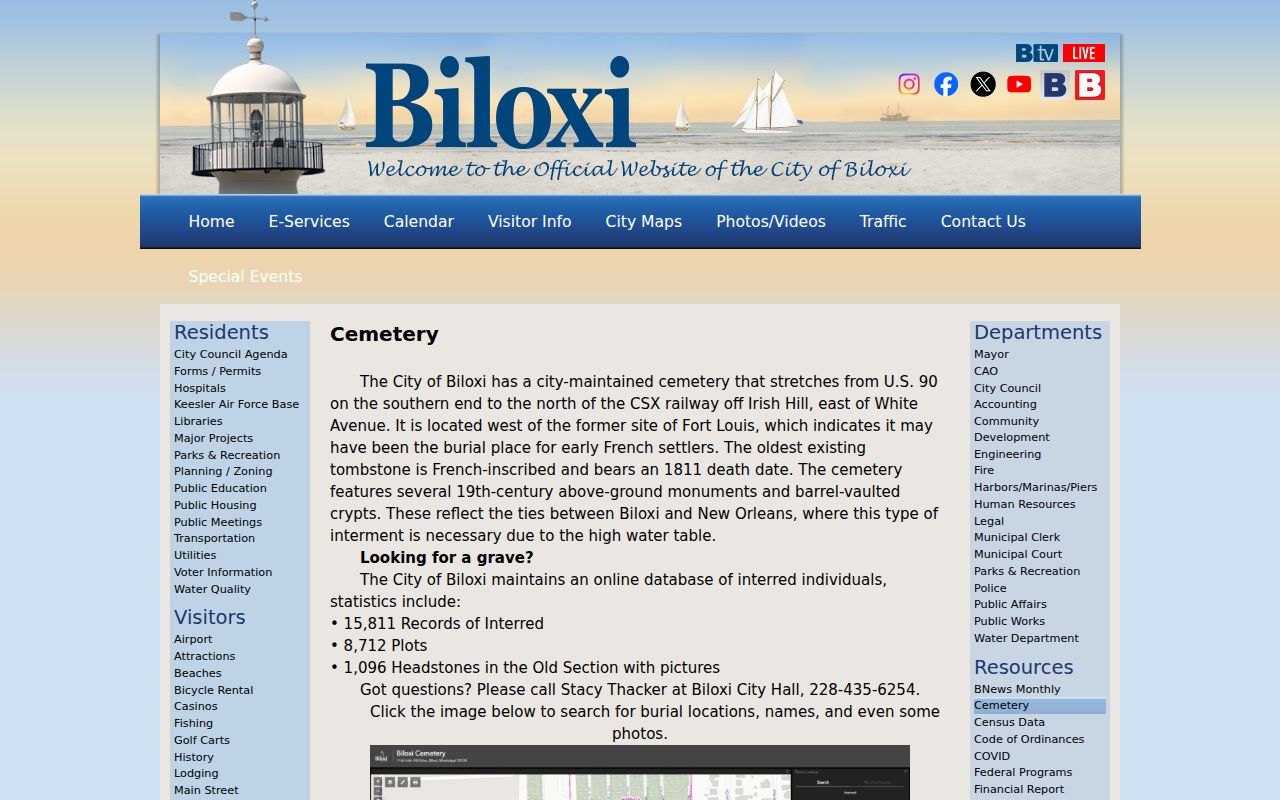
In short, Biloxi cemetery records add place and burial context to a dated trail of evidence, but a grave alone cannot establish where anyone currently lives.
Biloxi Library Records After Katrina
Biloxi's local-history collection survived a hurricane. Katrina pushed three to four feet of murky water and storm debris through the Murella H. Powell collection at the former 139 Lameuse Street library. The library has documented losses, replacement orders, and several temporary moves. Preservation support followed after 2005. In October 2008 the collections consolidated downtown. A missing directory volume may reflect that storm history rather than a failed name search in the residents directory.
Today the department sits at 580 Howard Avenue. Its material is noncirculating, and research requests work in person, by telephone, email, or mail. A microfilm and microfiche reader is available. Holdings add Bradford-O'Keefe Funeral Records from 1901–1960, cemetery index cards, obituary resources, yearbooks, deeds, marriages, wills, tax assessments, and newspaper microfilm. Special-collection availability can change, so calling ahead is sensible.
Note: The library is the practical fallback when a Biloxi historical record has no complete online path.
Biloxi Resident Search Privacy Limits
Mississippi built its access law in 1983. The Public Records Act, Miss. Code Ann. §§25-61-1 et seq., sets the baseline, but every record type carries its own exemptions and redactions. Vital records have eligibility rules. Voter sources exclude protected matching data. Court files can be sealed, juvenile, expunged, or restricted. An empty county-portal result does not prove a person has no record, and a visible record does not justify publishing sensitive details.
Not everything is online. Use the source's own request route when a record is not available there. City requests may go to the City Clerk. Older land or court material may wait at the Chancery counter or in the vault, while historical questions fit the library or the Mississippi Department of Archives and History. Preserve what the source says. Stop where its access rule stops.